Day-by-day embryo development

Day 0: Egg retrieval, sperm preparation and insemination
- On day 0, the egg and the sperm are combined ‘in vitro’ in a laboratory dish. This is known as insemination
- Only mature eggs have the capacity to fertilise
- On average, 70-80% of eggs retrieved are mature.

Day 1: Fertilisation assessment
- Around 70% of inseminated eggs fertilise – however, this can vary
- As egg and sperm each have a nucleus containing most of the cell’s DNA, fertilised eggs should display 2 pronuclei, each containing DNA from the egg and the sperm. Pronuclei is the name given to the nuclei of eggs and sperm after fertilisation, but before they fuse as part of the embryo development process
- Some eggs may fertilise irregularly, with 1 or 3 pronuclei visible. Some eggs may also stop the fertilisation process before the pronuclei form
- 24 hours after insemination, fertilised eggs (zygotes) start dividing. Ideally, this division is uniform. However, sometimes division is not uniform, which can reduce the likelihood of the zygote becoming a blastocyst.

Day 2: Cell division
- On day 2, we would like to see cell division (4 cells is ideal)
- Sometimes, fertilised eggs don’t divide. There are many reasons why this happens, and it can be related to the egg or the sperm.
- If an embryo has not divided for more than 24 hours, it is usually not a viable embryo (meaning it is unlikely to grow into a healthy foetus).
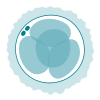
Day 2: 4-cell stage embryo
- Up until the 4-cell stage, the embryo relies on energy and nutritional stores from the egg to grow. After the 4-cell stage, there is a transition where the embryo becomes responsible for its growth. Some embryos do not make this transition and growth stops
- About 10% of embryos will not divide beyond the 4-cell stage.

Day 3: 6–8-cell stage embryo
- On day 3, we change the embryo’s culture media as it has different nutritional needs. Culture media is the liquid that the embryo is bathed in. It closely mimics the environment of a natural pregnancy
- We expect the cells in the embryo to have divided to around 6–8 cells by day 3
- At this stage, embryos begin to compact (meaning the cells are tightly squished together) and form junctions that link one cell to another. These junctions help the cells communicate.

Day 4: Morula stage embryo
- Embryos are usually at the 16–32-cell stage on day 4. However, it is not possible to count the cells as they are compacted.
- On day 4, some embryos start forming a fluid-filled cavity called the blastocoel cavity.
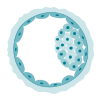
Day 5 to 6: Blastocyst stage embryo
- Embryos at the blastocyst stage have 2 different cell types, the inner cell mass (ICM), which becomes the embryo proper (foetus), and trophectoderm cells (TE), which become extraembryonic tissue such as the placenta
- Blastocysts can form on day 5 or day 6 and are transferred (i.e., the embryo is placed into the uterus) during a stimulated cycle. A stimulated cycle uses medications to prepare the uterus for transfer
- Blastocysts can be biopsied and/or frozen on Day 5 or Day 6, depending on when they are ready. A biopsy involves a small procedure to take a few cells from the embryo for genetic testing
- The majority of embryos that do not become blastocysts are chromosomally abnormal (i.e., they don’t have the correct number of chromosomes, which contain DNA)
- Embryos at the blastocyst stage have a 1 in 2 chance of having the correct number of chromosomes when the egg provider is 35 years or older
- About 30–50% of zygotes become blastocysts. However, this is variable, with the biggest factor being female age at the time of egg retrieval.
FAQs
-
How are embryos grown in the Newlife IVF lab?
All the embryos in our lab are grown in time-lapse incubators so we can constantly monitor their development and environment. We do not disturb the incubation of the embryos from the time we inseminate them (via intracytoplasmic sperm injection, known as ICSI) or the time we check for fertilisation (in traditional IVF) until day 3, when we replenish the culture media (the liquid the embryo is bathed in). The embryos are grown in replenished culture media that facilitates embryo development in the second phase of their growth. The media replenishment occurs in bespoke IVF chambers that control the environment and takes place within a few minutes, providing a safe environment for the embryos. Our culture system is highly supportive of embryo development. The embryos are grown up to day 6 after insemination until they reach the blastocyst stage.
Once the eggs have fertilised, we watch them grow and observe their developmental milestones. Some embryos show signs that suggest they may have reduced ability to reach the blastocyst stage. This may be a result of genetic, structural or metabolic issues.
-
Will all the eggs that have fertilised become blastocysts?
Usually around 30–50% of fertilised eggs become blastocysts. However, this is dependent mainly on maternal age, the reason for infertility and the resulting quality of the embryos. Generally, patients <35 years of age at the time of egg retrieval will have around 50% of the embryos reach the blastocyst stage. Patients 40 years and older will be closer to 30%. Of course, individual results vary greatly.
Egg quality is further influenced by diet and lifestyle factors. By addressing these modifiable factors and prioritising your overall wellbeing, you can boost your chances of conception and a healthy pregnancy.
Find out more: ‘Is there anything I can do to improve my egg quality?’
-
Why do embryos stop growing?
Many embryos stop growing because they exhibit chromosomal errors (genetic errors) that are ‘lethal’ for the embryo. For a comprehensive discussion, please read ‘Why did my embryos stop growing’.
-
Many embryos stop growing because they exhibit chromosomal errors (genetic errors) that are ‘lethal’ for the embryo. For a comprehensive discussion, please read ‘Why did my embryos stop growing’.
We expect to see the first embryo division around 24 hours after the egg and the sperm are combined (insemination). Generally, the zygote (fertilised egg) divides from a 1-cell to an even 2-cell stage embryo. However, sometimes the zygote may divide from 1-cell to 3 or 4-cells. This is known as multipolar division and may disrupt normal development. This can happen due to faults in the cell structures involved in cell division, poor energy production, or genetic or structural issues with the egg or sperm.
Embryos with irregular cell division have a lower chance of reaching the blastocyst stage because the DNA may not have divided correctly. These embryos may also have incomplete DNA replication or misalignment (an error in replication), which can result in embryos with missing or extra chromosomes (aneuploidy).
-
What is embryo fragmentation and why does it happen?
Human embryos are susceptible to fragmentation, which is when little pieces of the cell break off during cell division. A small amount of fragmentation may not affect the ability of the embryo to become a blastocyst. However, when there is considerable fragmentation and it affects several cells, the embryo is less likely to become a blastocyst. When we see large amounts of fragmentation across a set of embryos, we know the number of usable blastocysts may be lower in that cycle.
Scientists are still learning about the causes of fragmentation. There are many suggested reasons why an embryo may fragment, including sperm or egg quality, advanced maternal age, chromosomal abnormalities, adverse culture conditions (their environment), irregularities with the cell cycle, or cells undergoing apoptosis (programmed cell death). We cannot determine the causes of the fragmentation. Some patients may only experience fragmentation in a single cycle, whereas others may experience embryos that continually undergo fragmentation despite interventions.
-
What are ‘excluded cells’?
Sometimes a single cell within the embryo may be excluded, meaning it is separate from the embryo’s main structure. This may be an embryo’s way of removing unwanted cells that are irregular. The exclusion of a cell or a few cells doesn’t affect the developmental potential of the embryo and it can still reach the blastocyst stage.
-
Can sperm affect embryo development?
Both the egg and the sperm can affect embryo development. Although the quality of the egg is critical, sperm do play a significant role in the steps of embryo development. Genetic abnormalities, including abnormal chromosomal structure, increased DNA fragmentation and defective chromatin content, have been associated with poor growth or developmental arrest (where growth stops). Some sperm issues can also be linked to irregular division. Unfortunately, as we can only observe what happens to the embryos and cannot see what is happening internally, we are not able to determine if problems with embryo development are linked specifically to either the sperm or egg, or both. Find out more.
-
How does Newlife IVF select which embryos will be transferred?
Newlife IVF uses multiple sources of data when selecting which embryos are suitable for transfer to the uterus. These include our internal blastocyst grading system, the appearance and timing of development throughout the 5–6 days while the embryo is grown in the laboratory, together with artificial intelligence (AI). AI in our time-lapse system uses algorithms to score the embryos based on appearance, timing of divisions and other cell cycle events. Like all technology, AI does have its limitations, which is why we use it to support decisions along with our grading system and the embryologist’s regular examinations.
-
How does Newlife IVF select embryos for freezing?
Not all embryos are frozen during IVF. Chosen embryos must meet certain quality standards based on their potential to be viable embryos. Embryologists assess embryos based on:
- Developmental stage: Embryos that reach the blastocyst stage by day 5 or 6 are more likely to implant successfully. Embryos are assessed based on:
– Expansion: How well the embryo has expanded and formed a fluid-filled cavity (blastocoele)
– Inner cell mass (ICM): A high-quality ICM is dense with well-organised cells
– Trophectoderm (TE): The outer layer of cells that will form the placenta. Healthy blastocysts have a clearly visible trophectoderm. - Viability for freezing and thawing: Only embryos with an appropriate number of healthy ICM and TE cells can survive the freezing and thawing process and will be selected for freezing.
If an embryo does not meet these criteria, it may not be frozen, as it may not be viable for transfer after thawing.
- Developmental stage: Embryos that reach the blastocyst stage by day 5 or 6 are more likely to implant successfully. Embryos are assessed based on: